Loading training for new warehouse workers
Parcelademy
Five simple rules for loading parcels into walls that don’t fall.
5 rules · about 5 minutes
Left: three towers of four boxes each, stacked straight on top of each other. Right: the same kind of boxes in a T-pattern. Press Push to push both walls.
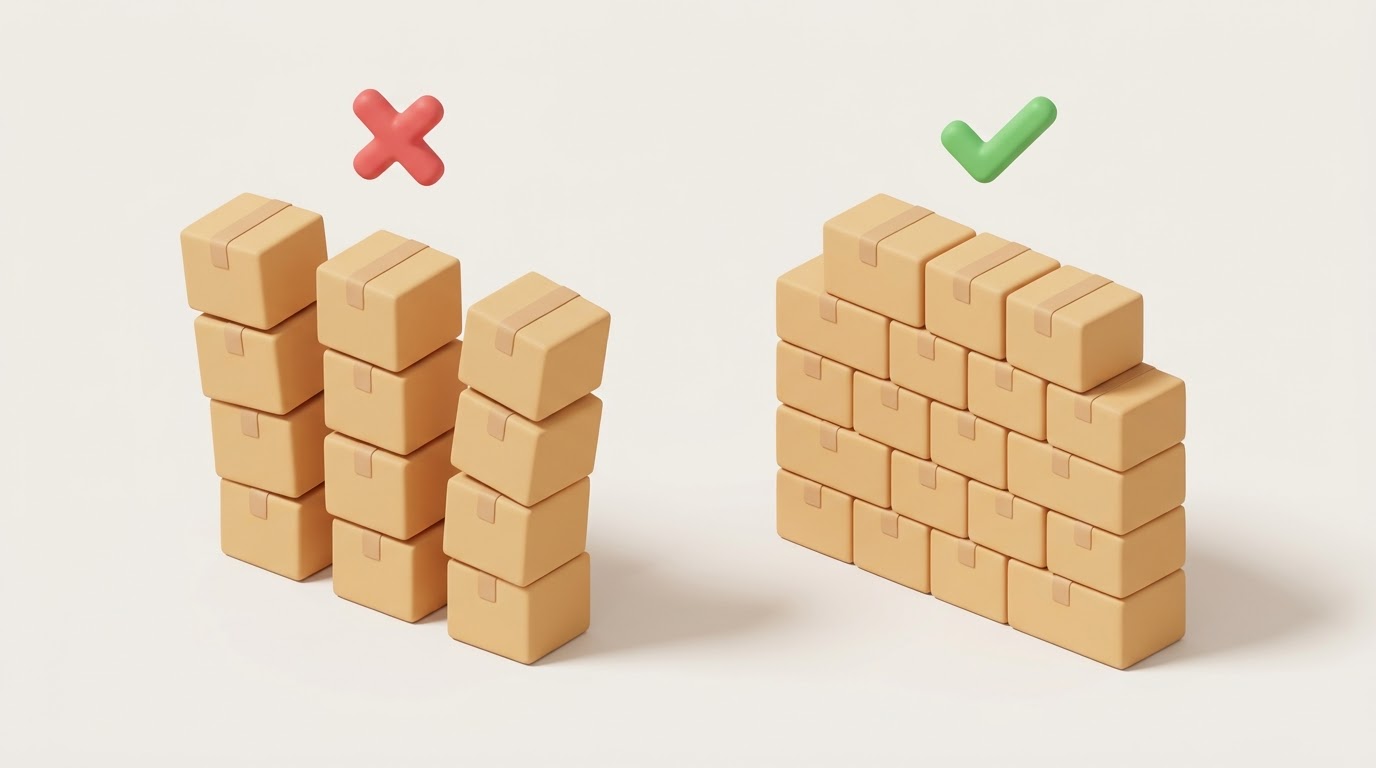
Two walls, the same boxes. Which one stands?
01 — The problem
New people.
Little time.
Many new workers in parcel logistics are temp staff who are only there for a short time. From day one, they must load stable walls of parcels.
Today, experienced colleagues teach them on the job. That works – but every explanation takes an expert away from their own work.
-
Short stays
Always someone new
Temp staff come and go. The training starts again with every new person.
-
Unstable walls
Walls can fall
A wall that is not stable can fall when the container moves. Parcels get damaged, and unloading gets dangerous.
-
Lost time
Experts are busy
Each explanation on the floor takes an experienced colleague away from loading.
The idea Parcelademy teaches the five most important rules – short, visual and before the first shift.
02 — The rules
Five rules for
a stable wall
Learn them once. Use them in every container.
-
T-pattern, not towers
Don’t stack identical boxes straight on top of each other – towers fall. Place them staggered: each box rests centered across two boxes below.
1 box on 2 boxes
Fig. 1 — Towers vs. T-pattern -
The wall
Stack the boxes in walls about 45 cm deep, from the floor to the ceiling. When a wall is almost finished, start the next one.
Depth ≈ 45 cm · floor → ceiling
Fig. 2 — Side view of a container · walls 1–3 -
Layer by layer
Build one layer at a time, for example from right to left. Keep the layer at a similar height, so the next layer fits on top.
Right → left · even height
Fig. 3 — Front view · scroll to build -
Straight front
Seen from the front, the wall is flat. No box sticks out, and no box is pushed back.
0 cm out · 0 cm back
Fig. 4 — Side view · front is on the right -
Heavy at the bottom
Heavy boxes belong in the lower layers. Light boxes go on top – so nothing gets crushed and the wall stays stable.
Heavy ↓ · light ↑
25 kg 2 kg 3 kg2 kg 3 kg 25 kgFig. 5 — Weight in the wall
03 — Checklist
The 5 rules
at a glance
Check your wall before you leave it. Tick each rule – or print this list and hang it up at the loading dock.
Parcelademy · wall check
0/5
These are general tips based on practical experience. Always follow the safety rules and instructions of your employer.
04 — Interactive training
In development
Practise in a
3D container
Soon you can load a container yourself: place boxes, build walls and get feedback on every rule – before your first real shift.
Unity WebGL · coming soon
05 — About the project
Built by someone
who loads walls
Hi, I’m Leon M. I study Information Systems at TUM and work in parcel logistics myself.
Working in a parcel hub, I kept seeing the same thing: new colleagues – often temp staff on their very first day – had to learn how to build stable walls within minutes, while experienced loaders lost time explaining it again and again. Parcelademy turns that know-how into five visual rules anyone can learn before their first shift.
Roadmap Next up: an interactive 3D training built in Unity, a German version, and testing the rules with new colleagues to see whether they get up to speed faster.
- Role
- Idea, content, design, code
- For
- New warehouse & parcel workers
- Built with
- HTML · CSS · JavaScriptAI-assisted development (Claude Code)
- Privacy
- 0 frameworks · 0 trackers · 0 cookies